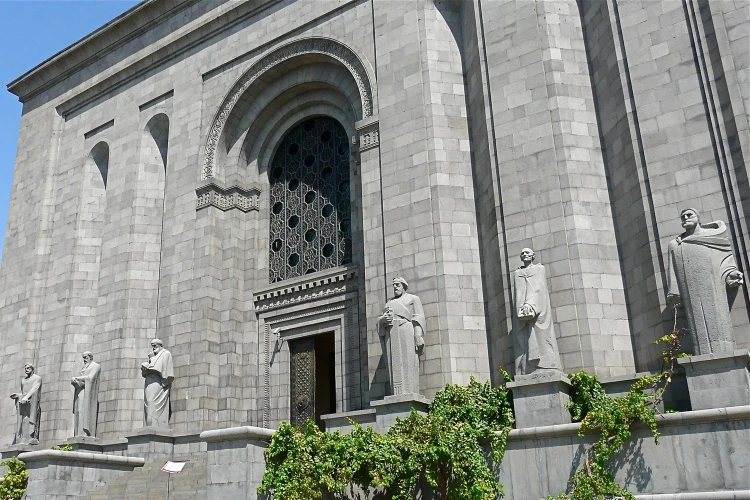

Matenadaran, Yerevan
A working research institute where centuries of Armenian writing become a museum experience


Before entering the Matenadaran, pause in front of the building. Mark Grigoryan’s basalt monument borrows the gravity of medieval Armenian architecture, while the figures along its facade suggest that the collection is not simply about books. It records an unbroken conversation between science, literature and art. The statues of Mesrop Mashtots and his pupil Koryun form a prologue that continues inside with original manuscripts.
First key: look at the material
At the display case, do not begin by trying to read every line. Notice the tone of the parchment, the density of the ink, the binding and the worn edge of a page. These clues reveal how a volume was made, handled and carried. Armenian manuscript culture extends far beyond religious texts: the museum presents works connected with history, medicine, geography, philosophy, literature and mapmaking.
Second key: find the human hand
On one page, the main text, a marginal note and an illumination may come from different hands. Look at the shapes of initials, the order of colours and the tiny expressions on painted faces. The manuscript then stops feeling like an anonymous old object and becomes a collaboration between real people. A guided tour is worthwhile on a first visit because it explains details that are easy to miss through the glass.
Third key: remember that the institute is alive
The Matenadaran is both a museum and a working research institute and repository. The pages on view are only a small part of its holdings; other manuscripts are studied, restored and preserved under controlled conditions. Allow 1.5-2 hours and verify museum days on the official website. Afterwards, walk to the Yerevan Cascade, continue to Republic Square, or choose another stop from GAVAG’s Armenia attractions. The Yerevan municipality also provides a short historical overview.
Frequently asked questions
Book a private transfer
Add this stop to your trip, see the full route on the map, and compare offers from local drivers.