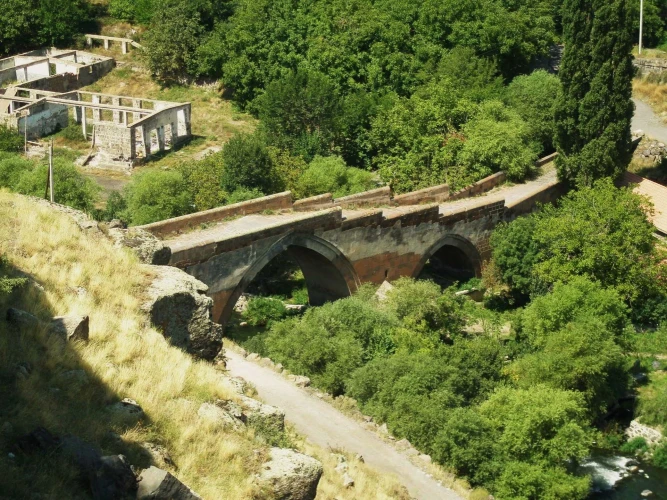

Ashtarak Old Bridge
A three-arched stone bridge built in 1664 across the Kasagh River in old Ashtarak


Ashtarak Old Bridge is more than a photogenic backdrop: it was a working link between two sides of Kasagh Gorge. Armenia’s Research Center for Historical and Cultural Heritage dates it to 1664 and attributes its construction to Motsakents Mahtesi Grigor. The clearest way to read the structure is to compare its three spans from above and from the side.
Three arches do not mean three equal spans
The largest opening carries the main channel while the smaller arches complete the crossing toward the banks. Their inequality is functional, matching the gorge width, available bearing points and water passage. Notice the pointed outlines and alternating tones of masonry. Do not descend beneath the arches after rain: flow and stone grip can change quickly.
An arch sends weight toward solid ground
Loads on the roadway travel through the curved stone rings into the side supports. Look beyond the openings to the masonry above them, the bridge-to-bank junctions and the narrow deck. Do not stop where you obstruct traffic, keep children close and never treat the parapet as a viewing platform.
An inscription preserves the patron’s name
The historical record mentions an inscription between a large and a small arch, associated with Motsakents Mahtesi Grigor. It may be difficult to read because of distance, light and surface condition. Never approach along an exposed edge or scrape the stone for a clearer view. Check the monument entry at Armenia’s heritage research center and the broader city route at the Armenian Travel Bureau.
Use two heights for a complete view
Begin at an open upper viewpoint where the bridge and winding gorge share one frame. Move closer only for masonry details, without climbing a wall or stepping onto unprotected ground. Morning side light often reveals the relief; summer foliage may hide parts of the smaller spans. Shoes with firm grip are useful in every season.
Connect the bridge to three different churches
Continue with three distinct forms: intact cross-domed Karmravor, broad basilican Tsiranavor, and small roofless Spitakavor. In this sequence the bridge becomes a spatial key to old Ashtarak rather than an isolated stop. Browse more ideas in the nearby attractions guide.
Frequently asked questions
Book a private transfer
Add this stop to your trip, see the full route on the map, and compare offers from local drivers.