
Tsiranavor Church Ashtarak
An early Christian three-aisled basilica whose open walls reveal construction, collapse and later defence


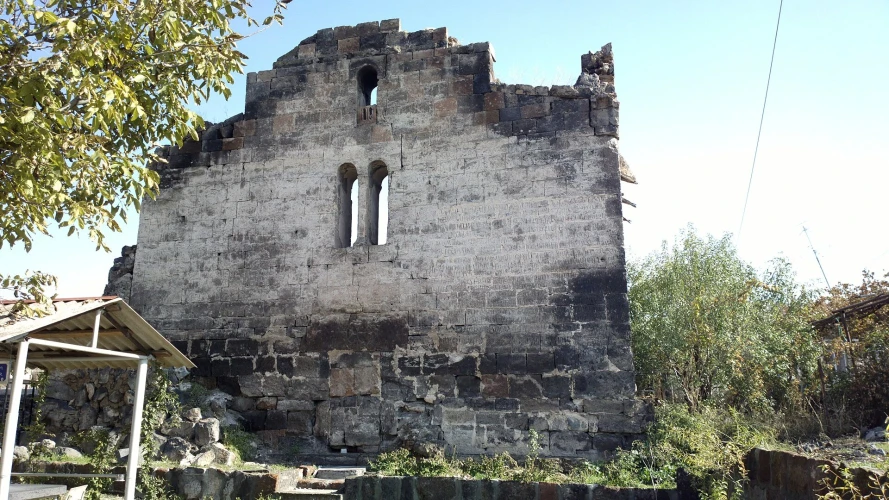
Tsiranavor Church is best read not as an incomplete church but as an exposed structure. The roof of this early Christian three-aisled basilica above Ashtarak’s gorge is gone, yet high walls, arches, supports and the horseshoe apse still allow the former space to be reconstructed.
Find the long axis
Look east from the western end: a broad central nave is flanked by narrower aisles. Longitudinal movement, not a domed centre like Karmravor, organizes the building. When judging wall height, remember that open sky now occupies the place of vaults and roof.
A pier base unlocks the plan
Use square bases and surviving piers to divide the interior into three aisles. Changes in masonry may indicate rebuilding or reinforcement rather than one original phase. North and west walls were strengthened for defence in the seventeenth century, so early fabric and later intervention stand together.
A ruin requires different conduct
The missing roof does not make the monument a climbing area. Keep off wall edges, respect barriers and never move fallen stones. Rain, snow and ice make surfaces slippery; strong wind also matters at an exposed gorge-edge site.
A carved slab is a document
Read cross and foliage stones as surviving layers, not automatically as details in their original positions. Photograph them with context so scale and placement remain clear. Never apply chalk, water or cleaner to improve an inscription.
Tsiranavor and Karmravor answer architecture differently
Armenia’s monument service identifies Tsiranavor as a major early three-aisled basilica. Compare its open longitudinal body with compact Karmravor and late-medieval Mughni Saint Gevorg. For another stone landscape, see Hrazdan Gorge, then browse the nearby attractions guide. A short summary is also available from ATB.
Frequently asked questions
Book a private transfer
Add this stop to your trip, see the full route on the map, and compare offers from local drivers.