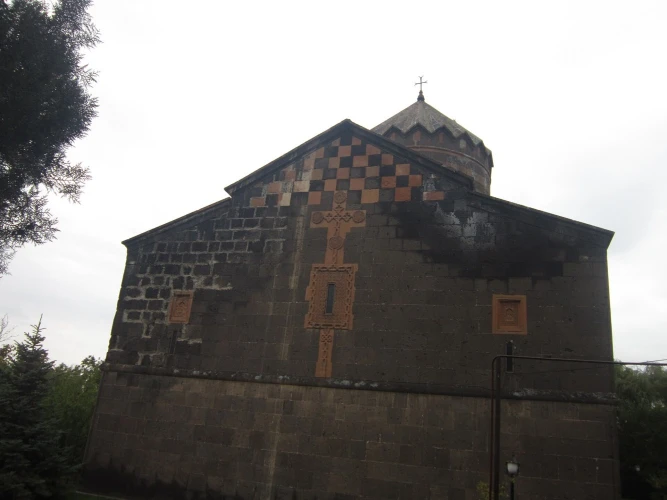

Mughni Saint Gevorg Church
A late-medieval church distinguished by a striped drum, carved portals and a rare three-arch western gallery


Mughni Saint Gevorg Church is recognised from a distance by colour rather than scale. Bands of reddish and pale stone rise through dark tuff toward the drum. The present church was rebuilt in 1661-1669 by Sahak Khizanetsi and, after him, Usta Murat.
Begin at the eastern facade
The cross-shaped mass, polychrome masonry and central carved cross are clearest here. Read the overall balance first, then smaller shifts around windows and reliefs. The late-medieval builders made a broad wall rhythmic rather than flat. Do not touch the stone or climb masonry for a photograph.
The western gallery is the architectural signature
An open three-arch gallery was built with the church, an unusual solution in Armenian architecture. Above it rises a twelve-column rotunda belfry. From the court, find the angle where arches frame the portal while the drum stays behind; this reveals how entrance, gallery and dome work as separate layers.
Inside, low light preserves traces of painting
Fragments of seventeenth-century murals survive and are associated by specialists with the circle of Naghash Hovnatan. Avoid flash and never touch painted surfaces. During a service, architectural inspection becomes secondary: silence the phone, wait, and do not cross in front of worshippers.
Read the khachkar from centre to edge
Locate the principal cross, then follow interlaced bands toward the border and lower rosette. Ornament divides the stone into centre, threshold and base rather than merely filling it. Stay on the established path among graves.
Plan a respectful visit
Mughni is an active sanctuary near Ashtarak, so daylight, modest clothing and quiet conduct work best. Verify architecture through Armenia’s monument protection service. Compare scale and period with Katoghike Church, adjacent Saint Anna and the modern Saint Gregory Cathedral, then browse the nearby attractions guide. A second architectural summary is available from ATB.
Frequently asked questions
Book a private transfer
Add this stop to your trip, see the full route on the map, and compare offers from local drivers.