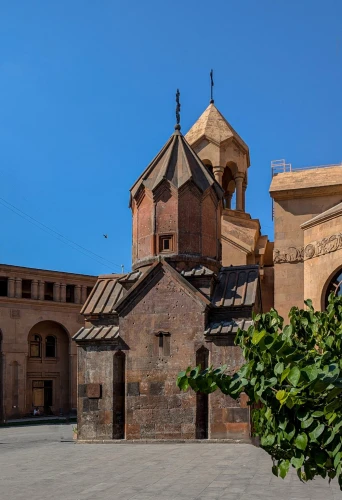

Katoghike Church, Yerevan
A 13th-century prayer space rediscovered inside a demolished basilica and preserved beside a new church


Begin understanding Katoghike Church with its scale. This tiny building does not dominate Abovyan Street, yet a wall inscription dated 1264 connects it directly with medieval Yerevan. Walk around slowly and distinguish weathered stone colour, inscriptions, carved crosses and restored sections.
A small church survived inside a larger one
After the 1679 earthquake, a large three-nave basilica was built here in 1693-1695. The medieval structure became enclosed and nearly forgotten. When the basilica was demolished in 1936, Katoghike emerged again and was preserved after archaeologists intervened. Its wall is therefore both architecture and a surviving layer of urban memory.
Scale changes behaviour inside
The prayer room is so compact that two loud visitors fill it with sound. Wait outside if someone is praying, silence your phone and keep the doorway clear. Notice how light from a small opening reveals the stone, while the close altar and candle stands hold attention in one direction. Do not touch carvings, icons or another person’s candles.
Place old and new in one frame
In the courtyard, find a viewpoint containing both Katoghike and Saint Anna, consecrated in 2015. The modern church’s volume makes the medieval chapel appear even smaller; the old building gives the new one historical depth. Keep their histories distinct, and during worship never walk between participants and the altar.
A central-Yerevan walk
Check contact details on the Yerevan Municipality page and history through Visit Yerevan. Continue to the Matenadaran or Opera Theatre, compare modern scale at Saint Gregory Cathedral, or browse GAVAG’s Armenia attractions.
Frequently asked questions
Book a private transfer
Add this stop to your trip, see the full route on the map, and compare offers from local drivers.