
Levon's Divine Underground
A private family museum beneath an ordinary house, carved by Levon Arakelyan with hand tools over 23 years


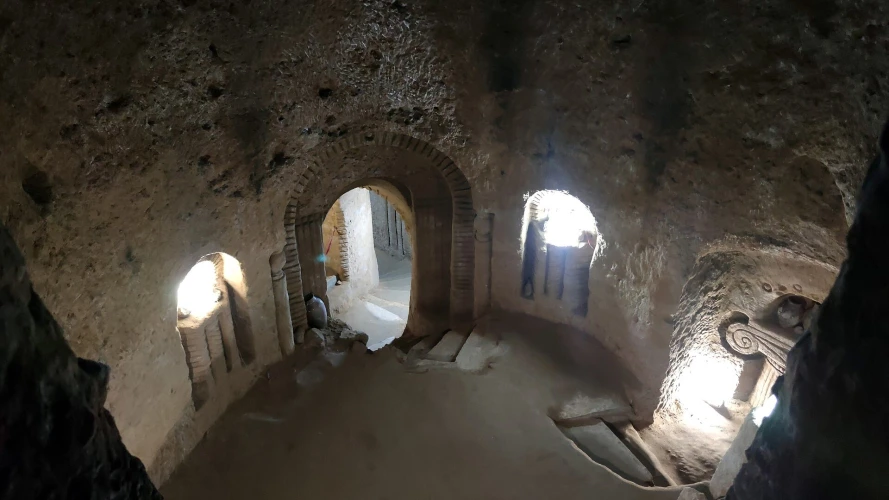
Levon’s Divine Underground is neither a natural cave nor an archaeological structure. Builder Levon Arakelyan shaped it by hand beneath his family home in Arinj. According to the family story, a request for a small potato cellar started the work in 1985; excavation continued for 23 years and became a network of stairs, arches and connected chambers.
Read the hall through movement before ornament
From the centre, notice how openings branch in several directions while curved walls and changing levels conceal the next room. This was not a conventional building completed from a fixed architectural plan; form developed as material was removed. Stay with the guide and do not invent a shortcut through an unfamiliar passage.
The tools give the most credible scale
Hammers and chisels in the display case return the achievement to the dimensions of one person’s hands. On the walls, look for repeated strike direction, a smoothed arch beside a rough surface, and transitions between worked zones. They reveal sequence. Treat accounts of visions and a divine plan as Levon’s and his family’s interpretation, not a measured engineering claim.
Your feet explain the depth
Sources commonly mention roughly 80 steps and a depth near 20-21 metres, but visitor conditions matter more than the number: narrow passages, low or uneven edges and a sustained climb back out. Wear firm non-slip shoes, keep your hands free and move slowly. If enclosed spaces, balance or mobility are concerns, discuss the route with the family before travelling.
It is a family home before it is an attraction
Access is normally accompanied by the family. Published hours and fees conflict across listings, so call or message ahead to confirm the date, price, payment method and language. The Armenian Travel Directory listing is useful for recent practical context. Do not touch carvings, tools or family exhibits without permission.
Continue through Kotayk’s different kinds of stone
Compare this hand-shaped interior with the rock-cut spaces of Geghard Monastery, then examine natural volcanic structure in Garni Gorge. A regional day can continue at Garni Temple, or use the nearby attractions guide. Free source photographs can be reviewed on Wikimedia Commons.
Frequently asked questions
Book a private transfer
Add this stop to your trip, see the full route on the map, and compare offers from local drivers.