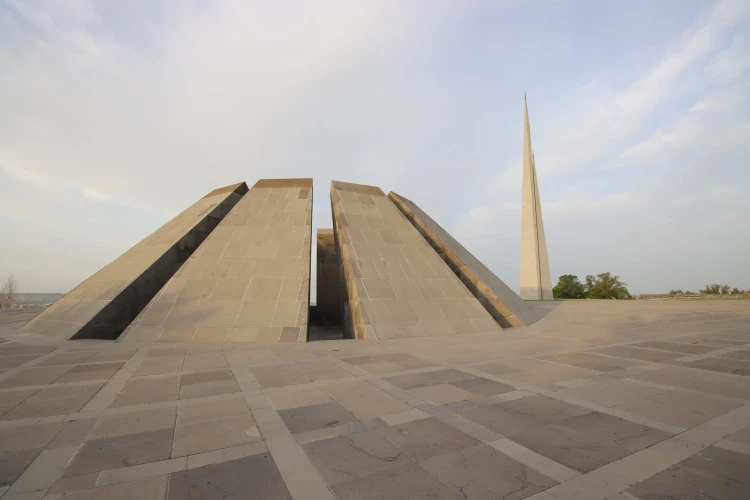

Tsitsernakaberd Memorial, Yerevan
A national place of remembrance shaped by stone, silence and historical testimony


A visit to the Tsitsernakaberd Memorial begins before you reach its central structures. The long approach and open ground gradually leave the city’s noise behind and create time to enter a quieter state of mind. This is not an ordinary sightseeing stop but Armenia’s national memorial to the victims of the Armenian Genocide, so the way you move through the site matters as much as what you see.
Between the stones
At the centre of the complex, opened in 1967, twelve inward-leaning basalt slabs encircle the eternal flame. Passing through the narrow gaps changes the experience from a broad horizon to an enclosed, concentrated space. Nearby rises the split memorial stele, while names carved into the remembrance wall return destroyed communities to the landscape through their place names. The architecture does not explain itself like a sign; it makes the visitor slow down.
From monument to testimony
The Armenian Genocide Museum-Institute is set into the hillside beside the memorial. Documents, photographs, personal accounts and maps establish the historical record. Leave enough time to read: moving quickly through this text-rich exhibition cannot convey its weight or careful sequence. Check current opening hours and possible access changes on the museum’s official website.
A simple code of conduct
Speak quietly, silence your phone and avoid obstructing people who are laying flowers or experiencing a private moment of remembrance. On 24 April, very large crowds gather and special traffic arrangements apply. On an ordinary day, allow 2-3 hours for both memorial and museum. Afterwards, continue Yerevan’s cultural history at the Matenadaran, or take a calmer walk through the Yerevan Cascade. More options appear in GAVAG’s Armenia attractions, while the CIPDH memory-sites platform provides international context.
Frequently asked questions
Book a private transfer
Add this stop to your trip, see the full route on the map, and compare offers from local drivers.