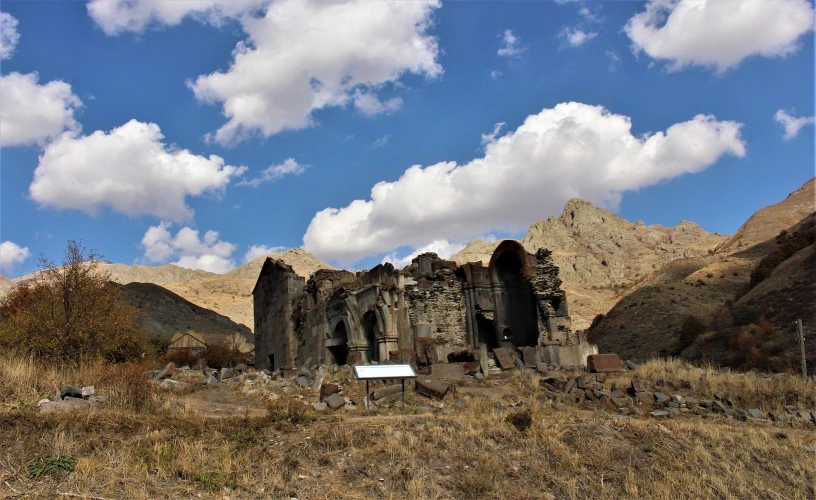

Arates Monastery
A mountain ruin where inscriptions still organize the story


Arates Monastery is not a ready-made postcard. The eye first registers collapse, then begins to recover the precise order that once held the complex together. It stands in historic Arates village near the Arates tributary. Treat the visit as a field notebook: every stop adds one observation to the same unfinished story.
Note 1: the buildings speak in a line
Four large and five small structures run north to south. Inscriptions record the names Surb Sion, Surb Astvatsatsin and Surb Karapet, although assigning every name to a surviving building is not entirely certain. The vaulted northern section is considered the earliest; farther south, the mass of a former domed church remains legible, with chapels and two gavits filling the intervals.
Note 2: open sky occupies the missing roof
The architectural highlight is the 1270 gavit associated with the architect Siranes. Intersecting arches once carried a central stalactite-form dome. The roof has gone, yet the standing arch and springing points of half-arches still let you reconstruct the engineering in your head. Do not climb the masonry: loose-looking fragments are not debris but parts of the monument.
Note 3: inscriptions work as labels
Written accounts of Arates are limited, while its walls preserve dedicatory and construction records. They document a thirteenth-century renovation under Abbot Hayrapet. In the same broad period, Stepanos Orbelian used Arates as an episcopal summer residence, and the monastery regained importance as a spiritual centre. Read the cut lines in angled light, without rubbing or wetting the stone.
Before closing the notebook
The final road is mountainous, and there is no ticket office, water point or permanent visitor service. Travel in daylight, check road conditions and carry a warm layer—even summer weather changes quickly. Continue through Hermon village, Yeghegis or Tanahat Monastery. Compare architectural notes with Armenian Geographic and the Hatis guide.
Frequently asked questions
Book a private transfer
Add this stop to your trip, see the full route on the map, and compare offers from local drivers.