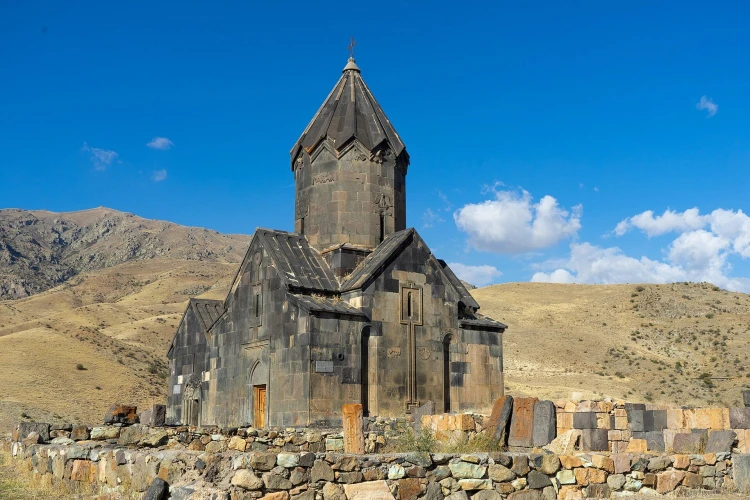

Tanahat Monastery
Two medieval churches and a stone bestiary on an open plateau


Reaching Tanahat Monastery does not feel like pulling into a conventional attraction. Beyond Vernashen, an exposed, nearly silent plateau opens up and two dark-stone churches appear without a ceremonial gateway. Read the complex through three questions: why are there two churches, what do the carved animals say, and how certain is the link with Gladzor University?
Question one: how do the two churches differ?
The anchor is Surb Stepanos Church, built in 1273-1279 under Proshyan patronage. A restrained rectangular exterior carries a twelve-sided drum, while the interior is cruciform with four corner chambers. The smaller Surb Nshan attached on the north is a single-nave church.
Question two: why are animals on the walls?
At Tanahat, sculpture is evidence rather than filler. On the south wall of Surb Stepanos, find the Proshyan emblem—an eagle clutching a lamb. Other scenes show animals in combat, while the lintel of Surb Nshan presents a mounted hunter charging a lion. These secular images combine princely authority, dynastic memory and Christian symbolism. Low side light makes their worn outlines easiest to read.
Question three: was this Gladzor University?
Tanahat is often promoted as a possible location of Gladzor University, but the identification is not settled. Recent scholarship stresses that the relationship among the names Tanahat, Tanat, Gharavank and Gladzor remains debated. That uncertainty improves an honest visit: separate the surviving architecture from the historical argument built around it. The European Journal of Archaeology explains the wider debate.
Three decisions before setting out
- Choose dry weather; the final dirt section can deteriorate after rain.
- Bring water, a hat and sturdy shoes because there are no visitor services on the plateau.
- Continue to Spitakavor Monastery, the Yeghegnadzor Regional Museum or Noravank.
For a concise architectural summary, compare your notes with the Hatis monument guide.
Frequently asked questions
Book a private transfer
Add this stop to your trip, see the full route on the map, and compare offers from local drivers.