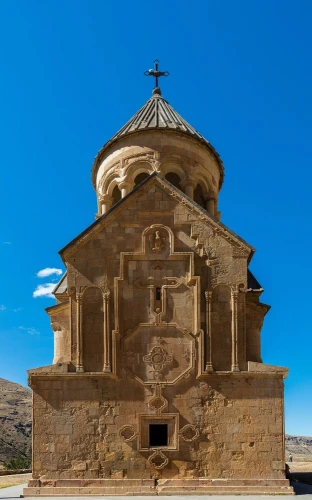

Noravank Monastery
Medieval monastery, red cliffs and one of Armenia’s most cinematic roads


Noravank Monastery is one of those places where the road prepares you before you even arrive. Leaving Yerevan for Vayots Dzor, the scenery gradually becomes drier, sharper and more open. Then the road enters Amaghu Canyon, and the red cliffs begin to close around the view. Noravank does not appear like a building placed beside the mountains; it feels as if the monastery and the canyon were designed to be read together.
What to see
The monastery developed in the medieval period, when Vayots Dzor was an important religious and cultural region of Armenia. The most memorable structure is Surb Astvatsatsin Church, famous for its two-level composition and narrow exterior steps. Climbing them is not difficult for everyone, but it does ask for care, and that small physical moment makes the visit more vivid. Around the complex, carved crosses, door frames, windows and sculptural details show the precision of Armenian stonework. Noravank is best seen slowly: walk around, step back, change the angle, and the same church will look different against every fold of the red rock.
Noravank in Vayots Dzor works well for a day trip from Yerevan, but it becomes even better when the route is not rushed. The drive usually takes a little over two hours, depending on stops. Many travelers combine Noravank with Areni-1 Cave or Areni wine village, because they sit naturally on the same direction. If you care about photographs, try to arrive in the morning or later in the afternoon. At those hours the cliffs carry deeper color, and the monastery does not flatten under harsh midday light.
You do not need special preparation, but a few practical details help. In summer, the canyon can be hot, especially around noon, so bring water and avoid treating the visit as a quick roadside stop. In winter, the road is usually possible, but after snow or ice it is wise to check conditions. Walking around the monastery is easy, yet the outer stairs of Surb Astvatsatsin are narrow and high enough to make comfortable shoes worthwhile. If you travel with children or older guests, give the place a slower rhythm; Noravank rewards attention more than speed.
The power of Noravank is not only in architecture. It is in the way medieval Armenian monastery design listens to the landscape. The cliffs are not decoration. They hold the light, the wind, the echo of voices and the silence that comes after a long road. Standing in the courtyard, you may first look for the famous postcard angle, but the stronger memory often comes when you turn back toward the canyon and realize why this place appears so often in photographs of Armenia.
Once you are there, look for the smaller signs as well as the big view. Noravank is famous for the red cliffs, but its details deserve time: the different tones in the stone, the carved crosses, the shadows around the windows, the sculpted faces near the entrances and the way the stairs change the rhythm of the building. Move from one side of the courtyard to another and the monastery seems to shift. From one point it looks vertical and bold; from another, it feels almost sheltered by the canyon. That changing relationship between structure and landscape is what makes the site feel alive.
A well-planned visit can easily become the center of a full day in Vayots Dzor. You can leave Yerevan in the morning, stop for wide valley views on the way, visit Noravank before the harshest midday light, and continue toward Areni later in the day. If you are interested in wine, caves or local food, the route is flexible enough to match your pace. The main thing is not to overload the day. Noravank is a place where an extra half hour often gives more value than another quick stop added to the schedule.
For photographs, most visitors first choose the open area facing the monastery, but the better set of images usually comes from moving around. Try the road before the final turn, the courtyard, the side of the stairs and the angles looking back into the canyon. If you travel with a group, agree on timing before everyone spreads out. Noravank naturally slows people down: one person stops by the carvings, another follows the cliff line with a camera, someone else simply sits in the shade for a few quiet minutes. The visit works best when your plan allows that difference in pace.
Families can enjoy Noravank as well, especially when the visit is organized calmly. Children often remember the canyon road, the color of the rocks and the dramatic stairs more than dates or names, but adults should be careful around the upper level of Surb Astvatsatsin. Older travelers do not need to climb the exterior stairs to appreciate the complex; the courtyard already gives a complete sense of the monastery. If your goal is to experience Vayots Dzor rather than just collect stops, Noravank deserves to be one of the main anchors of the day.
After the visit, do not rush straight out of the gorge. On the way back there are several safe viewpoints where the monastery can be seen again against the red cliffs. Stop only where the road allows it, look back at how the buildings fit the narrow valley, and leave enough daylight for the return journey.
Practical visit advice
If you include Noravank in a wider Vayots Dzor route, book a transfer with the Areni stops and the return drive agreed in advance, so the monastery does not become a rushed final stop. For more route ideas, browse our tourist attractions in Armenia. For historical background, see the Noravank article and Wikimedia Commons photos.
Frequently asked questions
Book a private transfer
Add this stop to your trip, see the full route on the map, and compare offers from local drivers.