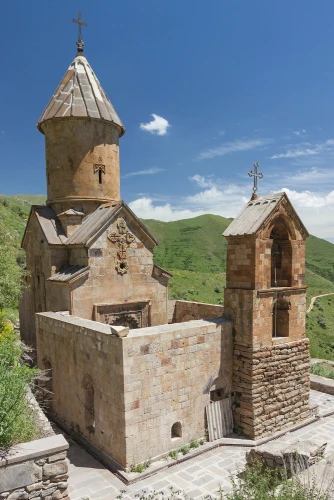

Spitakavor Monastery, Vayots Dzor
A 14th-century monastery reached after the asphalt ends


Above Vernashen, the road gradually sheds the sounds of village life. What remains is wind, open slopes and Spitakavor Monastery, a compact complex that does not rely on scale for effect. Its character lives in details, so resist the quick photo stop: circle the church and let the masonry reveal the story one surface at a time.
White stone is the first clue
Prince Eachi Proshyan began the Surb Astvatsatsin Church, and his son Amir Hasan II completed it in 1321. Its pale yellow felsite facing explains the name Spitakavor. The church is square outside, cruciform inside, with a tall drum and a sharply drawn conical roof. Walk around the south and west façades for relief crosses; angled morning or afternoon light gives the carving far more depth.
A doorway composed like a manuscript page
Above the western entrance, the Virgin holds the Christ Child. Dense geometric bands around the scene make the portal resemble the border of an illuminated manuscript. This close view is where Spitakavor's sculptural language becomes more memorable than the wide panorama.
An open gavit and a standing bell tower
The gavit added west of the church dates from 1321-1330. Its roof is gone, yet arches, wall niches and openings still define the room. In 1330 Hovhannes Proshyan and Tatch added the three-storey bell tower. Traces in the courtyard point to monastic cells, enclosure walls and a cemetery. The south side also holds the memorial and burial place of Garegin Nzhdeh; treat the grounds as both monument and place of remembrance.
The unpolished part of the itinerary
The final approach from Vernashen is an unpaved mountain road. Ask locally about current conditions; after rain, use a capable vehicle or hike. Carry water, sun protection and shoes with grip. Pair the visit with Yeghegnadzor, the Yeghegnadzor Regional Museum or Noravank Monastery. For an archaeological account of Spitakavor and nearby Proshaberd, consult Armenia Hidden Gems.
Frequently asked questions
Book a private transfer
Add this stop to your trip, see the full route on the map, and compare offers from local drivers.