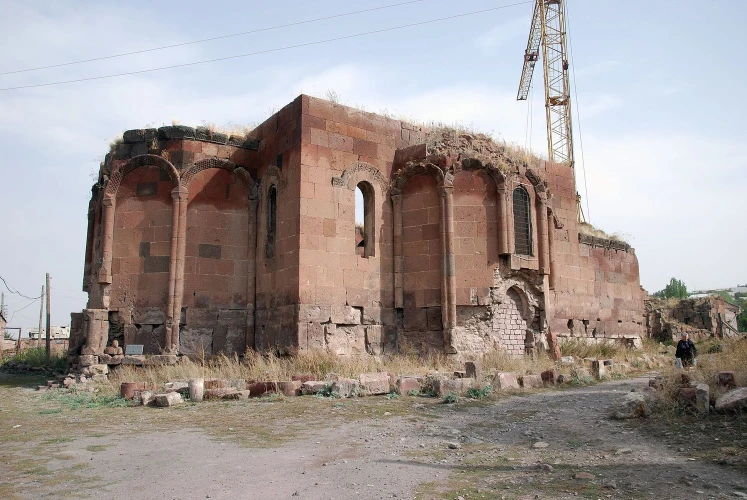

Artik Cathedral
A 7th-century tuff cathedral and a remarkable example of early medieval Armenian architecture


Artik Cathedral, also known as Saint Gevorg Church, is one of Shirak Province’s most remarkable early medieval monuments. Built in the 7th century from local reddish tuff, it has lost its dome and upper sections. The standing walls and arches nevertheless preserve enough of the original structure to convey the building’s former scale and architectural design.
What makes the architecture distinctive
Saint Gevorg belongs to the family of centrally planned, domed cruciform churches and is closely related in design to Mastara Church. Four projecting apses once met beneath a central dome, creating a spacious interior and a clear, balanced exterior. Although the dome is gone, the height of the surviving walls still indicates where the transition to its supporting structure began.
Look closely at Artik’s tuff
The rich colour of the local stone is one of the cathedral’s defining features. Paired arches on the apses rest on slender engaged columns and carved capitals. In the morning or late afternoon, angled light brings out the changing shades of the tuff, the rhythm of the arches and the finer carved details.
What to see inside
Begin with the semicircular apses, then look upward toward the surviving semi-domes and the open central space. From here, it is easier to imagine the original roof and dome. The masonry is fragile, so please remain at ground level and do not climb on walls, arches or fallen stones.
The neighbouring early church
East of Saint Gevorg stands a smaller and earlier church, referred to in different sources as Saint Astvatsatsin or Saint Marine. It is a separate monument rather than a chapel attached to the cathedral. Dating from the 4th–6th centuries, its design combines features associated with basilicas and domed cruciform churches. Further information about both monuments is available in the Armenian heritage research centre’s publication.
Planning your visit
The cathedral stands in central Artik, about 105 km from Yerevan. Allow roughly 40–60 minutes to walk around the site, view the interior and exterior details, and visit the neighbouring church. Early morning and late afternoon generally offer the best light. As the monument is open to the elements, comfortable footwear and weather-appropriate clothing are recommended.
Places to combine with Artik Cathedral
To explore more of Armenia’s early medieval architecture, continue to Talin Cathedral or Aruch Cathedral. For other ideas, browse the GAVAG guide to attractions in Armenia.
Frequently asked questions
Book a private transfer
Add this stop to your trip, see the full route on the map, and compare offers from local drivers.