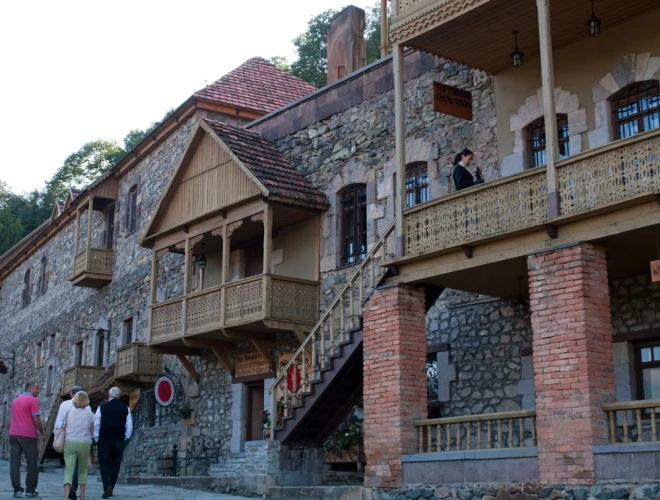

Sharambeyan Street, Dilijan
A restored historic street with wooden balconies, workshops and a museum


Sharambeyan Street is the best-known surviving historic streetscape in Dilijan. Its preserved and restored buildings display features of 19th-century Dilijan houses: stone lower floors, wooden upper levels, open balconies and carved details. Although the restored section is short, several buildings contain craft workshops, displays and other cultural spaces.
A historic street or a restored complex?
What visitors see today is the result of work carried out in different periods. The street bears the name of artist and cultural figure Hovhannes Sharambeyan, associated with efforts to preserve Dilijan’s traditional built environment. In 2004, Tufenkian began restoring the historic district while retaining forms characteristic of 19th-century local architecture. It is therefore more accurate to call this a preserved and restored historic setting, rather than an untouched old quarter. The project history is explained on the official Old Dilijan Complex website.
Details worth noticing during the walk
Look beyond the overall street view to the balcony supports, wooden railings, door frames and the combination of stone and timber. Together, these details show the importance of woodwork in Dilijan’s building tradition. Visitors interested in the surrounding landscape can plan a separate visit to Dilijan National Park. Working studios and handmade goods can be found along the street, although they do not share one fixed schedule. More background on its craft identity is available in the GoToDili guide.
The Esayan Museum and craft setting
The Esayan Museum inside the Old Dilijan complex is arranged as an example of a 19th-century Dilijan home. Its displays include handmade textiles, domestic objects and regional musical instruments. Confirm access to the museum and workshops in advance, because their hours may not match the time when you walk along the street. Some interiors belong to hotel, retail or working premises and are not automatically open to passers-by.
How to plan the visit
The outdoor street can be viewed at any time, while 60–90 minutes is usually enough for a considered visit. Mornings are quieter; evening light brings out the wooden façades. Sharambeyan Street is in the centre of town. On a monastery route, add Haghartsin Monastery on a monastery route.
Frequently asked questions
Book a private transfer
Add this stop to your trip, see the full route on the map, and compare offers from local drivers.