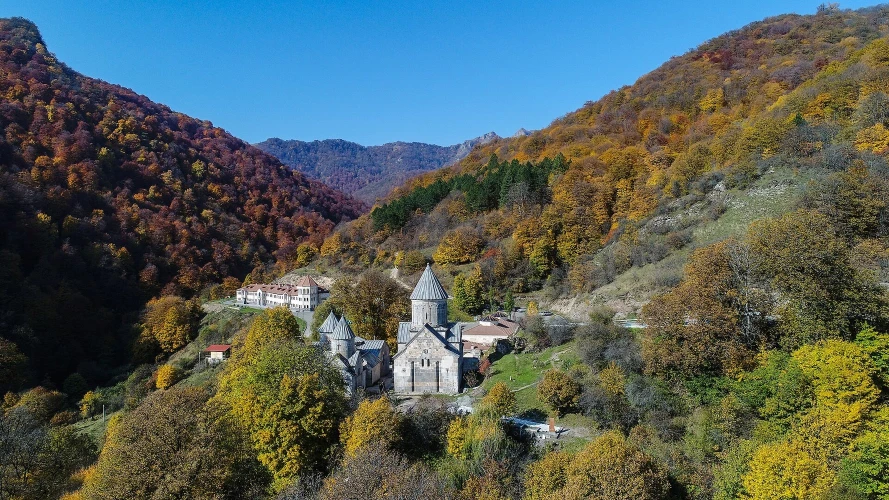

Haghartsin Monastery
A forest monastery where 10th-13th century churches, a vaulted refectory and carved khachkars turn the Dilijan road into a cultural stop


Haghartsin Monastery is one of the most rewarding stops near Dilijan, because the road and the monastery feel like one experience. As the forest grows denser, the first domes appear between the trees, and the visit begins before you even reach the courtyard. It is a good choice for travelers who want medieval architecture, cool mountain air and a peaceful stop without a long detour.
The forest is part of the visit
The road is generally comfortable, but weather around Dilijan changes quickly. Summer is cool, autumn is especially beautiful, and after rain the slopes can be damp. Haghartsin feels different from monuments standing in open fields: it is tucked into a green gorge, which makes the first view quieter and more memorable. To understand that setting, it also helps to look at Dilijan National Park; more background on the protected area is available in the official management plan.
Take a minute in the courtyard
Instead of walking straight into the churches, pause in the courtyard and read the ensemble: domes, roof lines, the long refectory and the way the buildings sit against the slope. The monastery is associated with building layers from the 10th-13th centuries; the historical data can be compared with the heritage article on hushardzan.am.
The refectory gives the place a human scale
Many visitors come for the churches, but the refectory often stays in memory longer. Its stone arches, thick walls and quiet light remind you that a monastery was also a place of shared daily life: meals, guests, pilgrims and community. If the room is not crowded, spend a moment there; the simplicity of the space works best in silence.
Look closely at the stone
Haghartsin’s khachkars, carved entrances and stone openings deserve close attention. The beauty here is not only in size, but in detail: floral lines, deep shadows and small irregular marks left by handwork. A tradition links the name with an eagle circling during the consecration, but even without the legend Haghartsin has a calm language of its own. Please avoid touching carved stones, especially in wet weather.
How to continue the day
Haghartsin combines well with Lake Parz if you want a gentle nature stop. For a richer cultural route, continue to Goshavank, then return to town for a walk along Sharambeyan Street. This turns a quick monastery visit into a balanced Dilijan day of forest, stone and town life.
Frequently asked questions
Book a private transfer
Add this stop to your trip, see the full route on the map, and compare offers from local drivers.