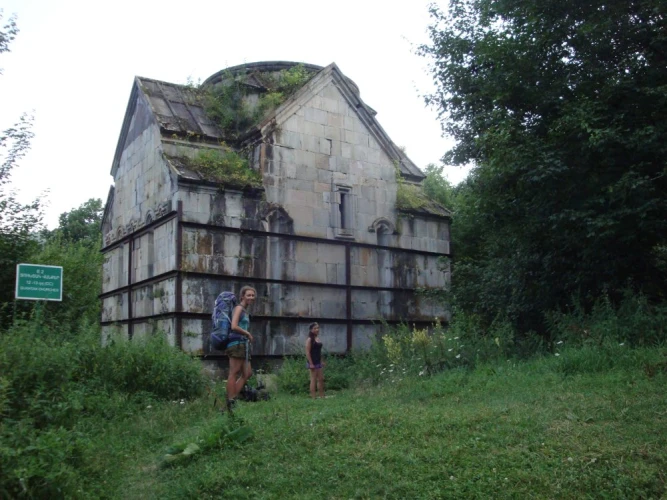

Jukhtakvank Monastery
Two medieval churches reached along a quiet forest trail


Jukhtakvank is a medieval monastic complex on a wooded slope about 3 km northwest of Dilijan. Its principal surviving buildings are the neighbouring Surb Astvatsatsin and Surb Grigor churches.
What the name Jukhtak means
The popular name means a pair and usually refers to the neighbouring Surb Astvatsatsin and Surb Grigor churches. Sections of the cemetery, khachkars and traces of other structures also survive around the churches. Inscriptions preserve the names Petrosi Vank, Petrosavank and Gisheravank as well. A detailed monument record is available from Armenian Historical Monuments.
Two churches with different histories
The inscription of the larger Surb Astvatsatsin Church dates its construction to 1201 and mentions vardapet Hayrapet. Nearby Surb Grigor is considered older, although its dome has not survived. Pale yellow stone, restrained volumes and inscriptions on the walls reward close viewing. Khachkars and gravestones from different periods remain around the buildings.
The forest trail is part of the visit
Reaching Jukhtakvank involves a walk through the forest. After rain, the ground may be muddy and slippery, while roots can be difficult to see. Wear firm footwear, keep an offline map and leave enough daylight for the return. The site belongs to the woodland setting associated with Dilijan National Park, where weather can change quickly.
A respectful, unhurried visit
This is not a ticketed attraction with guaranteed services or permanent staff. Carry water, take all litter away, and do not climb on walls or khachkars. Before departure, compare current access notes with the GoToDili guide. The outing can begin in central Dilijan; on a dedicated hiking day, it can also be paired with nearby Matosavank, allowing enough time for both trails.
Frequently asked questions
Book a private transfer
Add this stop to your trip, see the full route on the map, and compare offers from local drivers.