
Matosavank Monastery
A 13th-century monastery concealed among the forests of Dilijan


Matosavank lies in dense woodland about 3 km northwest of Dilijan. It was not a vast monastic centre: the surviving complex is compact and includes a church, a gavit, a book repository and nearby khachkars. Moss and vegetation partly cover the masonry, making the setting attractive but also slippery in wet weather.
Buildings that survive
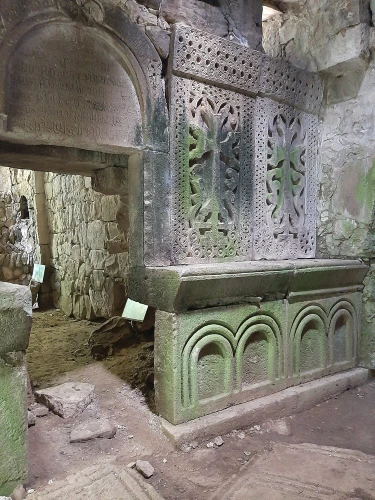
The principal structure is Surb Astvatsatsin Church. A gavit adjoins its western side, and the third building is a book repository. The church is a small barrel-vaulted structure built of large, semi-dressed stones. Its only entrance is on the west, with carved khachkars set on either side. The buildings’ present condition can also be examined in the Wikimedia Commons collection.
The date 1247 and the inscription
Surb Astvatsatsin Church is dated to 1247. According to the building inscription on the lintel of the western entrance, the church was built by Hordan. It is also known as Surb Astvatsatsin of Pghndzahank. The church, gavit and adjoining structures are also described in the Tavush guidebook.
Details that are easy to miss
Inscriptions, carved crosses and khachkars remain on the walls and among the surrounding stones. The interior receives little light and the floor may be damp. Do not move stones, climb on walls or damage moss-covered surfaces. A small torch is useful for viewing the darker sections inside.
Plan the forest route in advance
The trail to Matosavank is not consistently marked. After rain it becomes muddy, while wet leaves and roots can be slippery. Keep an offline map, wear firm footwear and return before dark. Dilijan is the practical starting point, and the Dilijan National Park page provides context for the surrounding landscape. Add nearby Jukhtakvank on the same day only in good weather and with enough time.
Frequently asked questions
Book a private transfer
Add this stop to your trip, see the full route on the map, and compare offers from local drivers.