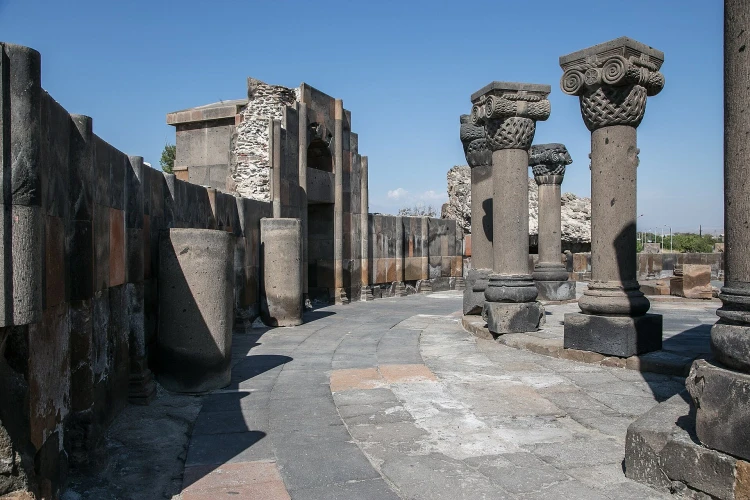

Zvartnots Cathedral Ruins
A seventh-century masterpiece reconstructed in the imagination from foundations, columns and carved stone


At the ruins of Zvartnots Cathedral, it is difficult at first to imagine the height and volume of the original building. What survives are foundations, sections of columns, arches and numerous carved stones. Together, these fragments make it possible to understand one of the boldest works of seventh-century Armenian architecture.
Begin with the cathedral’s ground plan
The cathedral was built in the mid-seventh century under Catholicos Nerses III the Builder. Its interior had four apses, while the circular structure presented a polygonal exterior. According to the widely accepted reconstruction, the building consisted of three progressively narrower levels and rose to approximately 45 metres. Zvartnots collapsed in the tenth century. The exact cause has not been established, although an earthquake remains one of the most common explanations.
After entering the site, walk around the outer edge of the foundations. From there, the circular plan, the position of the apses and the relationship between the central space and the colonnade become easier to follow. The reassembled arches do not reproduce the entire cathedral, but they help visitors understand its former scale and structure.
Examine the columns and carved decoration
The importance of Zvartnots is not limited to its ambitious dimensions. Look for basket-shaped capitals, vines and pomegranates, eagle sculptures and fragments depicting the builders. These details show that the exterior decoration received as much attention as the cathedral’s complex engineering. Do not climb or lean on the stones: many are original archaeological fragments.
See the entire complex, not only the cathedral
The archaeological site also preserves traces of the Catholicos’s palace, monastic cells, a bathhouse, a wine press and an earlier basilica. These remains show that Zvartnots was not simply a church; it functioned as a religious and administrative centre. If the indoor exhibition is open, allow time for finds from the excavations and materials explaining the proposed reconstruction.
Why Zvartnots is on the UNESCO list
Since 2000, the archaeological site has formed part of a UNESCO World Heritage property together with the Cathedral and Churches of Echmiatsin. The inscription recognizes the monuments’ role in the development of Armenian central-domed church architecture and their influence across the region. The full assessment is available on the UNESCO World Heritage Centre page.
Practical advice for the visit
Zvartnots is about 20 km from Yerevan. Allow 1-1.5 hours to explore the cathedral ruins, museum display and other structures at a relaxed pace. The grounds are exposed and have limited shade in summer, so bring water and a hat. Morning and late-afternoon light reveal the carved details particularly well. Check admission fees and seasonal hours on the official museum-reserve page.
Where to continue the journey
Continue to Vagharshapat and visit Etchmiadzin Cathedral and the city’s other early medieval churches. Back in Yerevan, compare the sculptural tradition with the medieval collection at the History Museum of Armenia. More ideas for future day trips are available in the Armenia attractions guide.
Frequently asked questions
Book a private transfer
Add this stop to your trip, see the full route on the map, and compare offers from local drivers.